Barcode vs QR Code: The Evolution of Digital Identification
Automatic product identification has radically changed how we consume. While the traditional barcode ruled the 20th century, the QR code has emerged as the indispensable interactive tool of the mobile era. Understanding their history means understanding the evolution of our need for speed and data density.
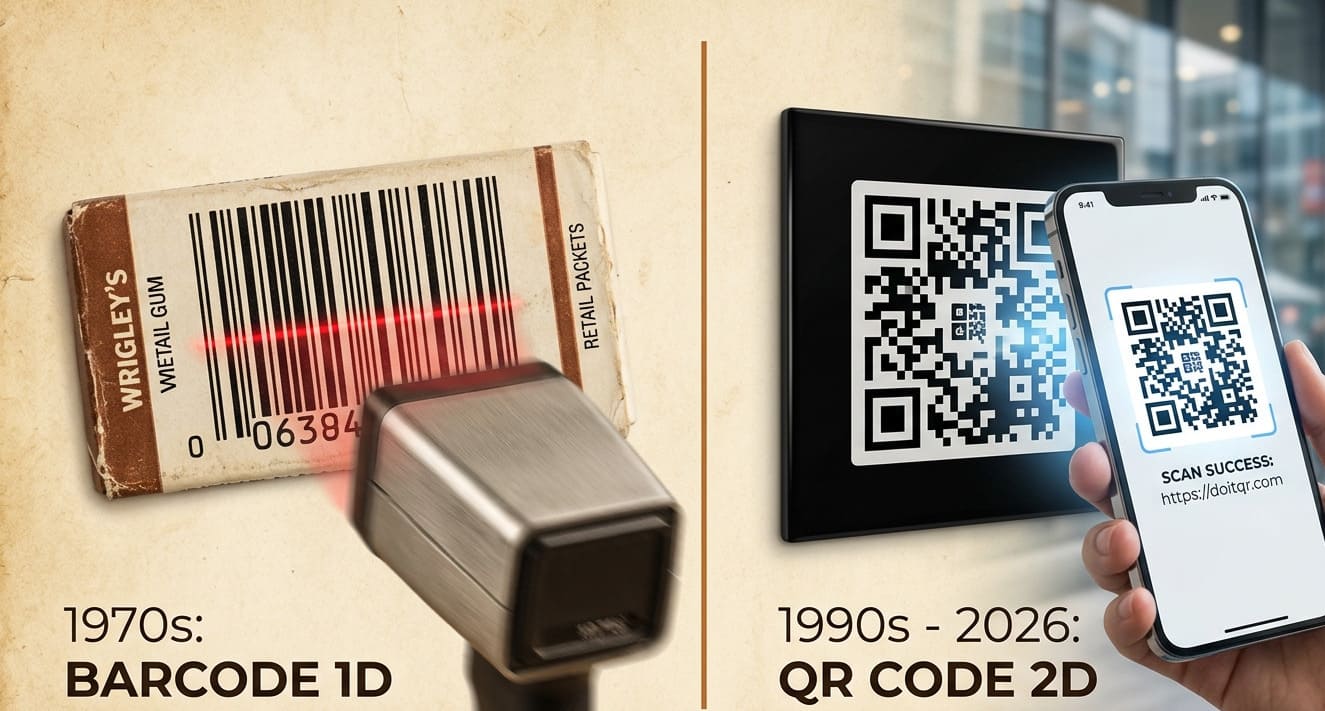
1. The Barcode: The Birth of a Revolution (1D)
Origins (1948-1974)
The story began in 1948 in Philadelphia. Norman Joseph Woodland and Bernard Silver sought a method to automate price reading. Inspired by Morse code, Woodland designed the first patent in 1952. However, it wasn't until June 1974 that the first commercial product (a pack of Wrigley's chewing gum) was scanned in Ohio using the UPC system.
Capacities and Technical Limits
Traditional barcodes are one-dimensional (1D). While consumer formats (EAN/UPC) are limited to about 13-25 numeric characters, denser logistic versions like Code 128 can theoretically store up to 80 or 100 characters. However, the more information a 1D code contains, the longer it becomes physically, which limits its use on small surfaces or for complex URLs.
2. The QR Code: The Answer to Complexity (2D)
The Denso Wave Invention (1994)
In 1994, Masahiro Hara, an engineer for the Toyota subsidiary Denso Wave, invented the QR Code (Quick Response Code). The need was industrial: tracking automotive parts with higher precision. Inspired by the board game "Go," he created a code readable from 360° thanks to its three detection squares.
The Superiority of Two-Dimensional Storage
Unlike a barcode, a QR code stores data both horizontally and vertically. This allows it to hold up to 7,089 numeric characters in an extremely small area. Most importantly, its error correction technology (Reed-Solomon) allows it to be scanned even if up to 30% of the code is damaged.
Did you know?
A 1D barcode requires an external database to be useful (the scanner looks up the price associated with the ID). A QR Code can contain the complete information (text, a vCard, or a link to doitqr.com) independently.
| Feature | Barcode (1D) | QR Code (2D) |
|---|---|---|
| Data Density | Low (ID only) | Very High (URL, Text) |
| Resilience | Zero if scratched | High (Error Correction) |
| Mobile Readability | Difficult | Optimal (Smartphone) |
Ready for the QR Code Era?
Generate your own professional and unlimited codes in seconds.
Access DoItQR Generator